
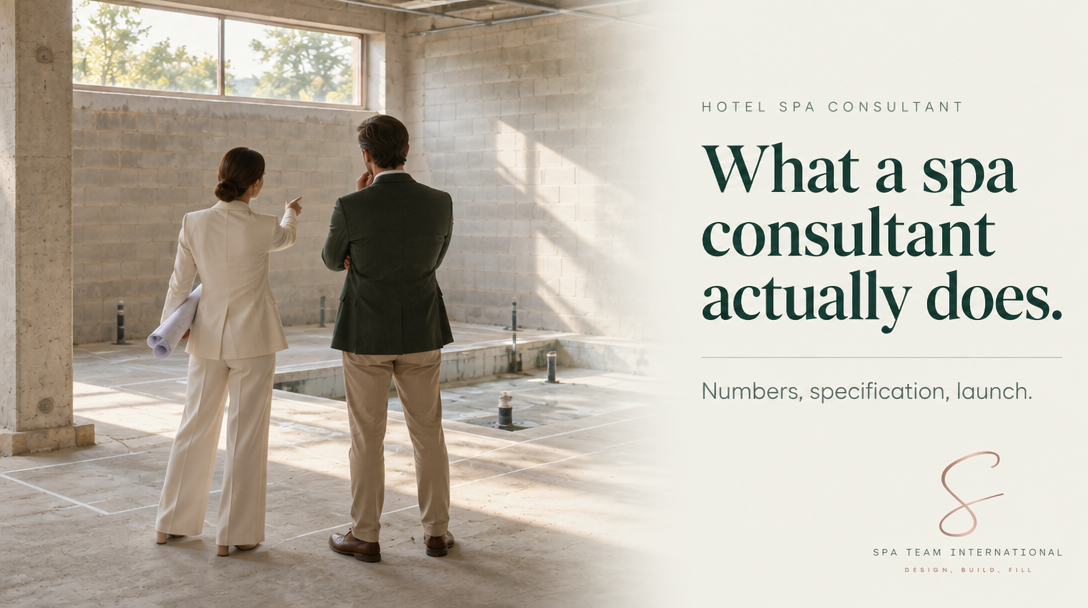
What a Hotel Spa Consultant Does From Concept to Launch: A Plain-Language Guide for Owners
What a hotel spa consultant is accountable for across a project The concept, design, procurement, training, and 90-day launch phases How to scope a partner and what the free audit actually covers
Most spa projects that underperform were not built badly. They were briefed badly. A treatment room that sits empty at three o'clock, a wet area that takes two attendants to turn over, a steam system that was sized from a round number: none of those are construction failures, they are specification failures, and they are decided months before anyone lifts a tile.
That is the gap a hotel spa consultant exists to close. Here is what the role actually covers, stage by stage, in plain language, and how to tell a good one from an expensive one.
The Short Answer: Four Things a Consultant Owns
A spa consultant owns the commercial and operational thinking that sits between the owner's ambition and the construction drawings:
Related equipment & services
Planning a spa opening or upgrade?
Pre-opening / refresh spec — wholesale through Spa Team International.
- The business case. What the spa will earn, what it will cost to run, and whether the investment is worth making.
- The design brief. What the space has to do, in operational terms, so the architect and interior designer can draw it well.
- The specification. Exactly what equipment, finishes and systems go in, priced properly and delivered on schedule.
- The launch. Hiring, training, menu, pricing, pre-opening marketing and the first ninety days of operating data.
If a project has someone accountable for all four, from one desk, the decisions stay connected. When the four are split across a designer, a contractor and a supplier, they usually stop being connected, and the owner carries the consequences.
Where Spa Projects Go Wrong Without One
- The room is drawn before the revenue model exists, so capacity and treatment mix are guesses.
- Wet-area equipment is specified inside a general construction package by people who do not work on thermal areas weekly.
- Attendant labor is treated as an opening-week detail rather than a permanent operating cost built into the layout.
- Equipment is bought at retail through the construction chain because nobody knew wholesale access was available.
- Launch is left to the opening date, so the first three months are spent learning what should have been planned.
Each of these is cheap to fix on paper and expensive to fix in a building.
Stage 1: Concept and Business Case
This is the stage that decides the return. Expect the consultant to work through the local market, the competitive set, the guest mix the property actually attracts, and the treatment and wet-area mix that fits it. The output is a space program, a capital range and a revenue model with a payback view, including a sensitivity check for lower occupancy and slower member uptake.
If a consultant starts with mood boards and finishes with a business case, the order is wrong.
Stage 2: Design Brief and Design Coordination
A spa is a building within a building: steam, water, humidity, acoustics, drainage, ventilation and back-of-house circulation all behave differently from a hotel corridor. The consultant's job is to translate operations into requirements the design team can draw to:
- The guest sequence, from arrival and robe change through warm-up, treatment, cool-down, relaxation and retail.
- Peak-window capacity, so the hot rooms, showers and loungers do not become bottlenecks.
- Labor efficiency, so the room can be staged, served and reset by the number of attendants you can staff.
- Technical protection: vapor migration, drainage falls, slip resistance, waterproofing details and humidity control around adjacent spaces.
- Acoustics and privacy, so treatment rooms stay quiet when the wet area is busy.
A good engagement improves the drawings rather than replacing them. The consultant is not the architect, and should not try to be.
Stage 3: Specification, Pricing and Procurement
Specification is where capital budgets drift. The consultant produces the equipment schedule and the wet-area package, sizes the steam system to real room volume, finish materials and recovery requirements, and coordinates the control and water-treatment systems as one package with one warranty.
This is also where procurement choices show up in the numbers. Buying at wholesale and direct from manufacturers rather than through the construction chain removes margin layers and shortens lead times, which protects the opening date. A consultant without wholesale access is only doing half of this stage.
Stage 4: Training, Menu and Pricing Before You Open
The operating model has to exist before the doors do. Expect support with recruiting and handover to the spa director, hands-on protocol training for therapists and attendants, treatment and retail menu development, price architecture and packages, and retail opening inventory sized to realistic attachment rather than optimism.
Stage 5: Launch and the First Ninety Days
An opening date is not a launch plan. The last ninety days should run in sequence: commissioning and testing of steam and water systems, staff hiring and training, menu and pricing finalization, a pre-opening marketing sequence to members and in-house guests, and a soft open with real booking data before the public push.
The soft open is a live experiment. Track utilization by hour, dwell time, treatment-to-wet-area conversion and retail attachment. Adjust staffing, sequencing and pricing on the evidence, then lock the operating model and hand over a reporting rhythm the owner can hold the team to.
What a Consultant Does Not Do
A consultant is not the architect, not the general contractor and not a product dealer. The role is not to replace the spa director either: the director runs the business, the consultant builds it and hands it over with the tools to run it.
Knowing this keeps scope clean and prevents the classic conflict, where the specification quietly bends toward whichever supplier pays the consultant.
When to Bring One In
The earlier the better, and there are three clear moments:
- Before the concept drawings are fixed. Feasibility, sizing and the revenue model are cheapest to change here.
- Before capital is committed. A second opinion on the specification and the operating cost is worth far more than a redesign later.
- On an underperforming spa. Repositioning an existing wet area, treatment mix and price architecture often recovers more value than a new build.
Also bring one in before buying equipment, even if the project is otherwise running well.
How to Tell a Good One: Questions to Ask
- Do you model ROI and payback before design, and will you show me the sensitivity?
- How many spa projects have you taken through to launch, not just through design?
- Do you have wholesale and direct manufacturer access on wet-area equipment?
- Who is accountable if the room underperforms in year one?
- How are you paid, and does your compensation depend on which equipment is specified?
- Can I speak to two owners whose projects you launched three years ago?
That last question matters more than the first. A consultant's value shows up in year three, not at handover.
How the Fee Model Should Work
Transparent fee-for-service is the cleanest structure, because it removes the incentive to specify equipment that pays the consultant rather than the property. Where a commission or vendor arrangement exists, it should be disclosed in writing before the specification is written, and priced into the comparison.
What a Complete Engagement Delivers
A concept and market position, a business case with payback views, a design brief and drawings review, a capital and operating budget, an equipment specification and procurement schedule, staffing and training support, a menu and pricing architecture, a ninety-day launch plan, and a first-year reporting pack.
The Standard to Design To
A year after opening, a well-consulted spa looks different from a well-drawn one. Utilization is understood by hour rather than by month. Labor is staffed to real demand. Retail attachment is a planned outcome with a path through the layout. And the owner has a business case they can compare against actual trading, rather than a set of drawings they cannot explain.
Spa Team International has delivered design, wholesale equipment, financing and launch support across 200+ luxury spa projects and $2B+ in portfolio value since 1997, with one team accountable from concept to launch. If you are planning, repositioning or upgrading a spa, start with a free, no-obligation audit of your space, your market and your revenue potential. There is no sales pitch, just a clear view of what your spa can realistically deliver.
Enquire with Spa Team International
Planning a spa opening or upgrade?
Pre-opening / refresh spec — wholesale through Spa Team International.